Product thesis
How Modeus routes one task across several AI models.
A task can include research, analysis, writing, code, and media generation. Those steps have different difficulty, different modality, and very different prices. Routing them separately is not an optimisation trick — it is the difference between paying for capability you need and paying for capability you do not.

One task is rarely one kind of work
Take a request a marketing team might actually send: research the top three competitors in our market, pull their pricing changes over the last two quarters, write a positioning brief, and produce a chart for the deck.
That is four kinds of work. Finding and reading sources is retrieval and judgement. Extracting pricing changes is structured comparison. Writing the brief is long-form generation with a house style. Producing the chart is code plus a rendering step. Only one of those four genuinely needs the strongest available reasoning model, and the answer is usually the brief, not the retrieval.
The default in most AI tools is to send the entire request to one model and let it do everything. That guarantees you overpay for the mechanical parts and, on a mid-tier model, underserve the part that actually carries the decision.
The price spread is inside every provider's own lineup
The gap is not subtle, and it does not require switching vendors to find. Anthropic's published pricing puts Claude Opus 5 at $5 per million input tokens and $25 per million output tokens, while Claude Haiku 4.5 sits at $1 and $5 — a fivefold difference on both sides of the exchange, inside one product family.
OpenAI's lineup is wider still: GPT-5.6-sol is listed at $5.00 per million input and $30.00 per million output, while GPT-5.6-luna is $0.20 and $1.20. That is a 25x spread on input for models you reach through the same API key.
Both providers also price cached input at roughly one tenth of standard input, which means the shape of what you send matters as much as which model you send it to. That is a separate argument, and we make it in why each step should receive focused context.
Prices verified 2 August 2026 from each provider's public pricing page. Model pricing changes often — treat the ratios, not the absolute figures, as the durable point.
The research on routing is unusually consistent
Academic work on this arrived before the products did. FrugalGPT (Chen, Zaharia and Zou, Stanford, 2023) observed that LLM API fees "can differ by two orders of magnitude" and showed that a cascade — try a cheap model, escalate only when confidence is low — could match GPT-4's performance with up to 98% cost reduction, or beat it by 4% at equal cost.
RouteLLM (Ong et al., LMSYS and UC Berkeley, 2024) trained routers on preference data and reported cost reductions of over 85% on MT Bench while retaining 95% of GPT-4's performance, using GPT-4 for only 14% of calls. On MMLU the saving was 45%, on GSM8K 35%.
Anthropic's own engineering guidance describes routing as a first-class workflow pattern: it "classifies an input and directs it to a specialized followup task," allowing "separation of concerns, and building more specialized prompts." Their worked example sends easy and common questions to a smaller, cost-efficient model and hard or unusual ones to a more capable model.
The consistent finding across all three is that most requests in a realistic mix do not need the frontier model, and that identifying which ones do is a tractable problem.
What routing looks like as a workflow
Routing only works if the task has been broken into steps that can each be judged. Modeus treats that decomposition as the first stage of the work, not an implementation detail:
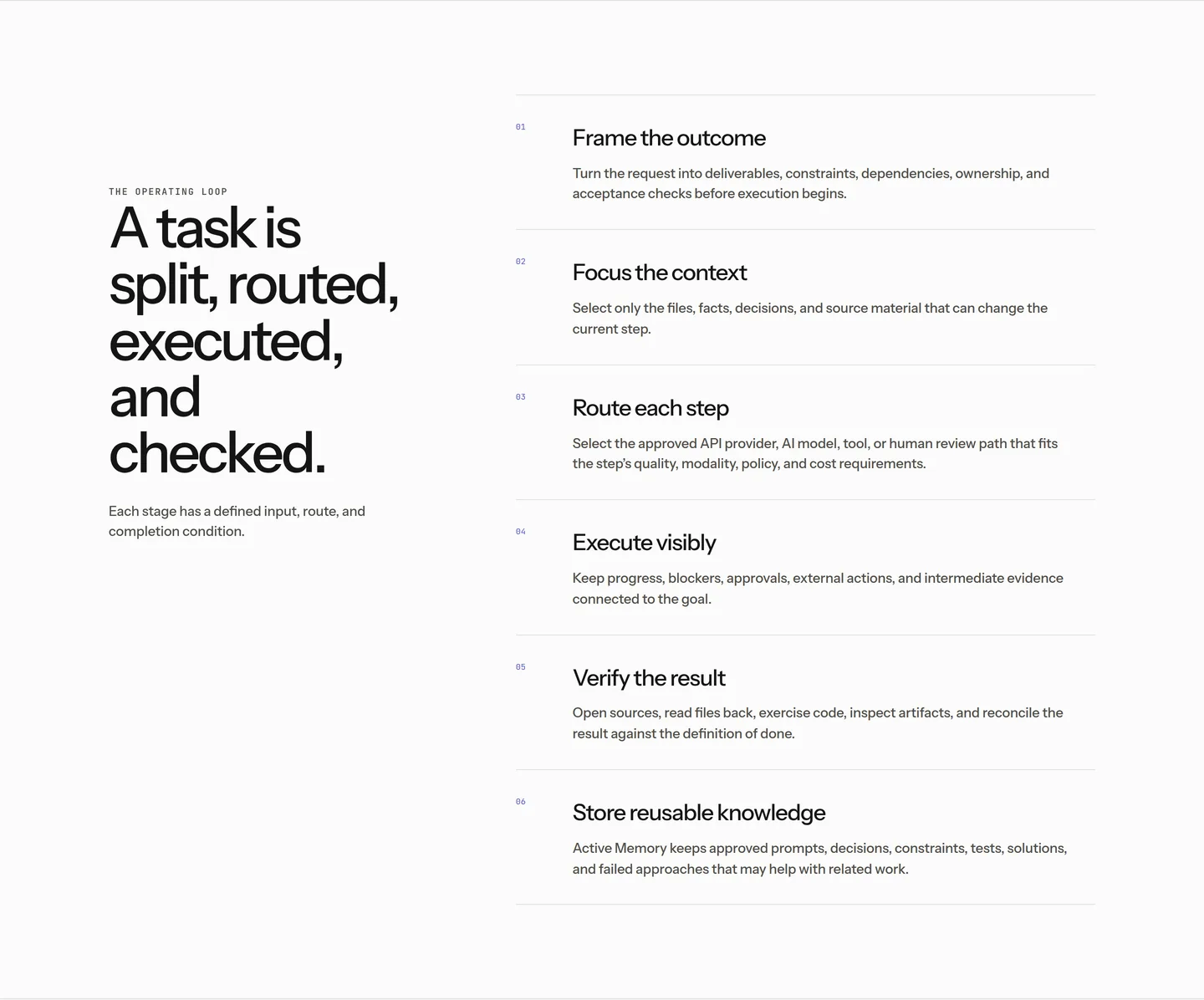
Framing the outcome produces the deliverables, constraints, and acceptance checks. Focusing the context selects only the files and decisions that can change the current step. Only then does the router have something specific enough to price: a step with a known modality, a known quality bar, and a known policy boundary.
The detail of how the selection is made is on the Smart Routing page. The short version is that a step carries four requirements — quality, modality, policy, and cost — and the route has to satisfy all four, not optimise one.
Choosing between models needs a shared evidence base
Routing decisions are only as good as the data behind them. A router that has an opinion about which model is "better" without a defensible basis is just a preference with extra steps.
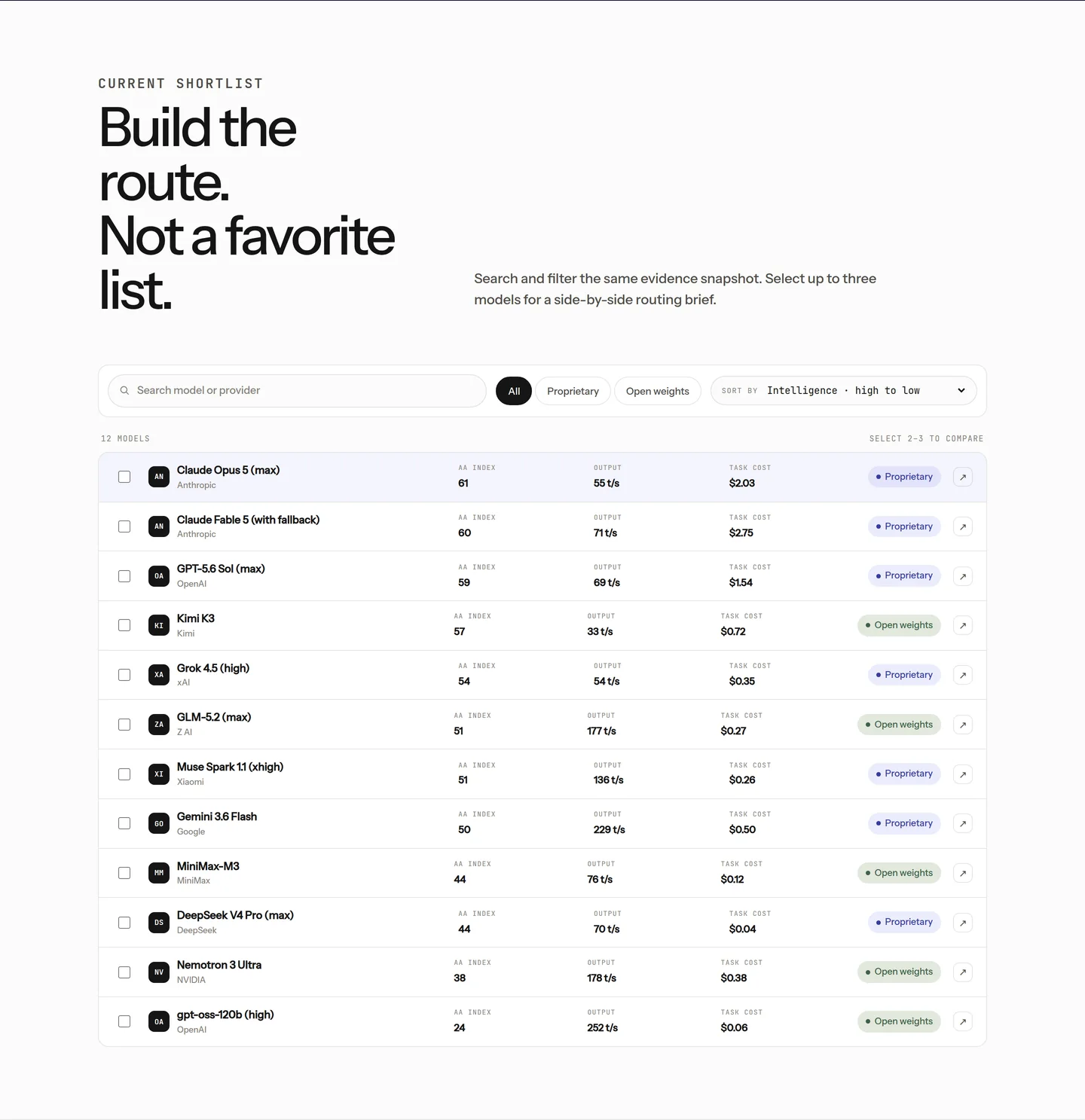
Publishing the comparison matters for a reason that is easy to miss: it makes the routing policy auditable. If a step went to a cheaper model and the output was weak, you can see what the router believed at the time and change the policy, rather than guessing.
Where routing does not help
Three honest limits.
Routing has its own cost. Classifying a step consumes tokens and adds latency. On short, uniform tasks the overhead can exceed the saving. Routing pays off on multi-step work with genuinely mixed difficulty.
Classification can be wrong. A step that looks mechanical but is not will get a cheap model and a poor result. This is why the loop above ends in verification rather than routing — see verification is part of the deliverable.
Tight coupling defeats it. If step four cannot be judged without the full reasoning trace from step two, splitting them costs more than it saves. The same constraint governs parallelism, which we cover in parallel work without duplicated effort.
Routing is not a way to get frontier results from budget models. It is a way to stop paying frontier prices for work that was never hard.
Sources
Every figure in this article was read from the source below on 2 August 2026. Where a source carries no publication date, an access date is given instead.
- Building Effective AI AgentsDefines the routing workflow and the orchestrator-workers pattern.
- RouteLLM: Learning to Route LLMs with Preference DataCost reductions over 85% on MT Bench while retaining 95% of GPT-4 performance.
- FrugalGPT: How to Use Large Language Models While Reducing Cost and Improving PerformanceUp to 98% cost reduction at matched performance; API fees differing by two orders of magnitude.
- PricingOpus 5 at $5/$25 per MTok against Haiku 4.5 at $1/$5.
- PricingGPT-5.6-sol at $5.00/$30.00 per 1M tokens against GPT-5.6-luna at $0.20/$1.20.