Research
What makes research defensible.
A research deliverable is defensible when someone who disagrees with it can check it and find that it holds. That is a higher bar than fluent prose with footnotes, and the measured gap between the two is larger than most teams assume.

Citations are not the same as support
The reference measurement is Evaluating Verifiability in Generative Search Engines (Liu, Zhang and Liang, Stanford, Findings of EMNLP 2023). Across Bing Chat, NeevaAI, perplexity.ai and YouChat, the authors found that only 51.5% of generated sentences were fully supported by their citations, and only 74.5% of citations actually supported the sentence they were attached to.
These systems were not hallucinating URLs. They were citing real pages that did not say what the sentence claimed. That failure mode survives every check that only verifies whether a link resolves.
Fabricated references now survive into the literature
The fabrication problem has been quantified at corpus scale. LLM hallucinations in the wild (Zhao et al., Cornell and UC Berkeley, May 2026) measured hallucinated citation rates across preprint and publication venues as of August 2025: arXiv 0.39%, bioRxiv 0.21%, PubMed Central 0.27%, and SSRN 1.91% — totalling 146,932 hallucinated citations in 2025 alone.
Two findings from that paper are the ones that matter for process design. 78.8% of non-existent citations passed arXiv moderation. And 85.3% of hallucinated references in preprints persisted into the published journal version. Human review at both stages did not catch them.
An independent estimate from ETH Zurich's SPY Lab put the arXiv rate lower — around 0.025%, roughly 1 in 4,000 references — while noting their method is "a (very) strong underestimation" because it only detects arXiv-title matches with mismatched author lists. The estimates differ by an order of magnitude; both are non-zero, and both trend upward from early 2025.
Models are trained to guess rather than abstain
OpenAI's Why language models hallucinate gives the mechanism, and the numbers are unusually clarifying. On SimpleQA, o4-mini abstained on 1% of questions, scored 24% accuracy — and had a 75% error rate. Meanwhile gpt-5-thinking-mini abstained on 52%, scored slightly lower at 22% accuracy, and had a 26% error rate.
The model that answered almost everything looked better on accuracy and was wrong three times as often. Binary scoring rewards confident guessing over acknowledging uncertainty, and a research process that only measures "did it produce an answer" reproduces exactly that incentive.
Grounding measurably helps — when it is structural
The encouraging counterpart: attaching generation to retrieved spans, structurally rather than by instruction, moves the numbers. Anthropic's Citations feature reports up to a 15% increase in recall accuracy over custom prompt-based implementations. One customer, Endex, reported source hallucinations dropping from 10% to 0% alongside a 20% increase in references per response.
The design lesson is that "cite your sources" as an instruction and "generate only from these retrieved spans" as an architecture produce different reliability, even with the same model.
A working standard
Four properties make research checkable. Each one is a thing you can fail.
Source coverage. State the population you tried to cover, the selection rule, and the gaps. Research that does not declare its scope cannot be shown to have missed anything, which sounds like a strength and is the opposite.
Contradiction checks. When two sources disagree, the disagreement is the finding. Suppressing it to produce a clean narrative is the most common way a brief becomes indefensible — and the SPY Lab and Cornell estimates above are a live example of two credible sources differing by an order of magnitude.
Traceable claims. Every number ties to a source that a reader can open, and the source says the number. Given the 51.5% figure, this has to be verified per claim, not per document.
Decision-ready synthesis. The deliverable answers the question that was asked, states what remains unresolved, and says what would change the conclusion.
How this runs as a workflow
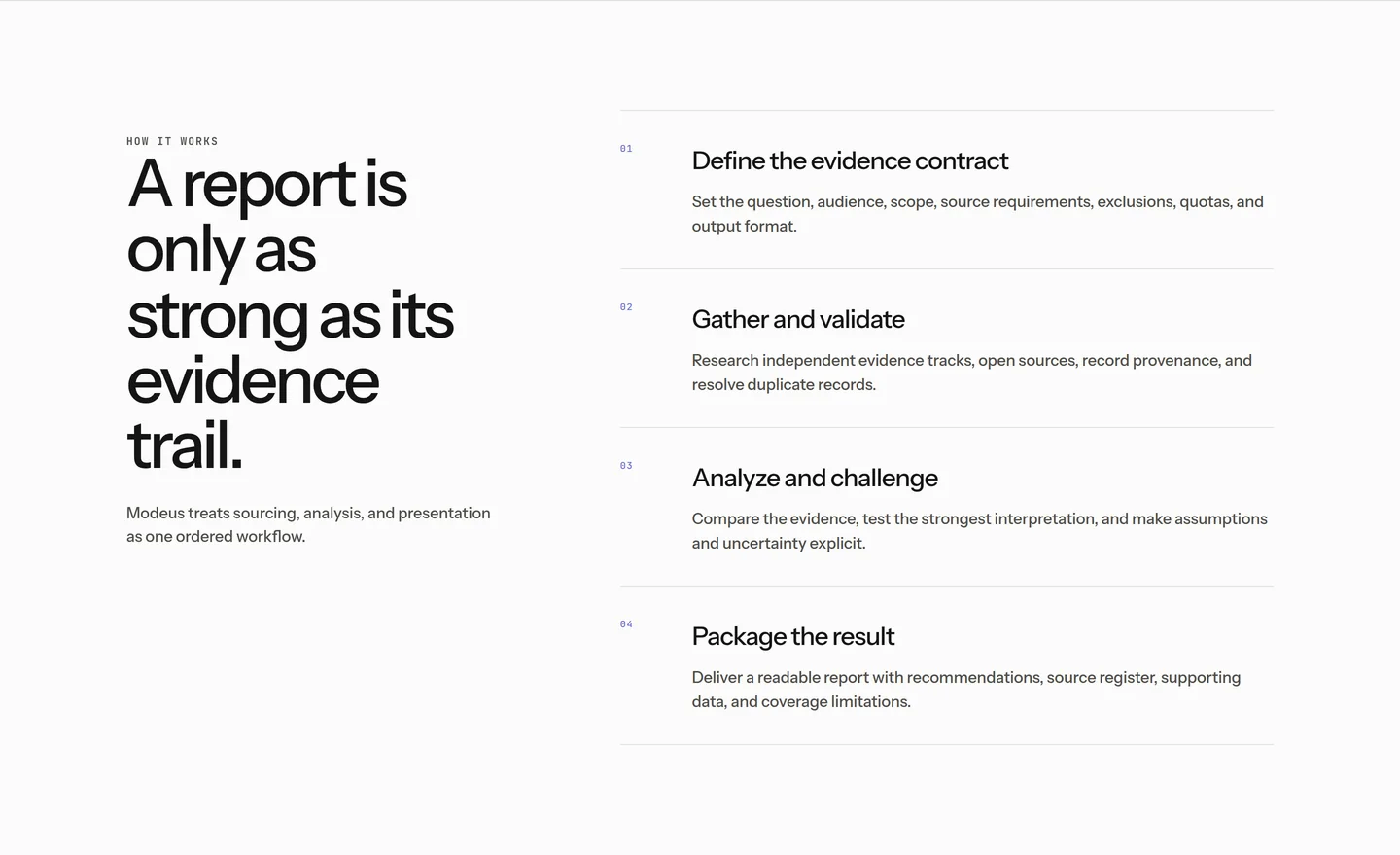
Two structural choices follow from the evidence above. Verification is a distinct step with its own route rather than a self-check appended to generation — the reasoning for that is in verification is part of the deliverable. And coverage is reported alongside the findings, including quota shortfalls and unresolved gaps, which is why the Wide research contract requires them up front.
None of this makes a model more truthful. It makes untruth visible before the brief reaches whoever has to act on it.
Sources
Every figure in this article was read from the source below on 2 August 2026. Where a source carries no publication date, an access date is given instead.
- Evaluating Verifiability in Generative Search Engines51.5% of generated sentences fully supported; 74.5% of citations support their sentence.
- LLM hallucinations in the wild: Large-scale evidence from non-existent citations146,932 hallucinated citations in 2025; 78.8% pass arXiv moderation; 85.3% persist to publication.
- Why language models hallucinateo4-mini: 1% abstention, 75% error rate against gpt-5-thinking-mini: 52% abstention, 26% error rate.
- Introducing Citations on the Anthropic APIUp to 15% higher recall accuracy; Endex source hallucinations 10% to 0%.
- Trends in LLM-Generated Citations on arXiv~0.025% of arXiv references appear hallucinated, described by the authors as a strong underestimate.